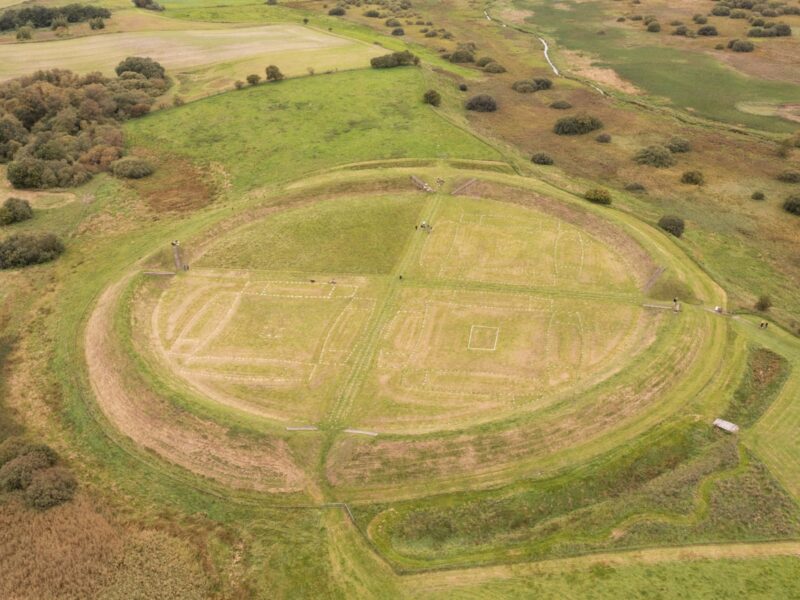
Around the year 980, King Harald Bluetooth built several Viking fortresses in Denmark – Fyrkat is one of those we know today. The old fortresses no longer exist, but they were built at a time when Denmark was united into a single kingdom, and the unique history of the fortresses have placed them on UNESCO’s world heritage list.
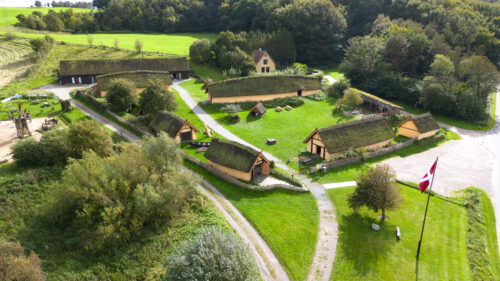
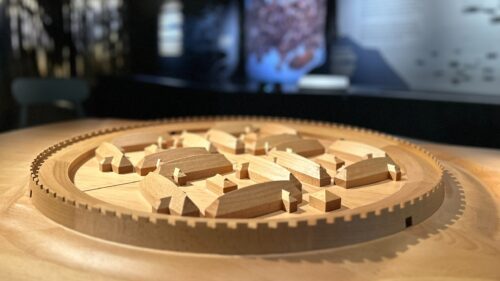
At Fyrkat, a natural sized rampart marks the original location of the Viking fortress, which encircled 16 large longhouses. One of these longhouses has been reconstructed and is open to visitors.
Not far from the fortress you may also visit a number of houses which in combination constitute a reconstructed nobleman’s estate from the Viking Age.
The Viking Museum Fyrkat
Within the Danish realm, we know of five ring fortresses dating back to the time of King Harald Bluetooth. At Fyrkat, an earthen rampart marks the site of the former fortress, and right next to it stands a reconstructed longhouse.
The Chieftain’s Farm at Fyrkat consists of nine reconstructed houses from a nobleman’s estate dating back to the time of King Harald Bluetooth.
At the museum you can experience an exhibition about Fyrkat with some of the finds excavated here. It also tells the full story of the five Danish ring fortresses, Harald Bluetooth’s spiritual guide (The Fyrkat völve), and the transition from Norse mythology to Christianity.
At the Viking Museum Fyrkat, there is a mythological playground where children have the opportunity to play among the Norse gods, listen to tales of the gods in the storytelling hut, sit in Odin’s chair, ride on Odin’s eight-legged horse Sleipnir, and much more.
The five Danish ring fortresses – Aggersborg, Fyrkat, Nonnebakken, Borgring, and Trelleborg – have been included on UNESCO’s World Heritage List because, together, they represent a unique period in world history.