For 400 years, Jens Bang’s Stone House has stood proudly in the heart of Aalborg as a symbol of the city’s wealth and central importance during the Renaissance. Remarkably, the beautiful building has withstood the test of time and today remains an exceptionally well-preserved burgher’s house from the 17th century – significant not only locally in North Jutland, but also at a national level.
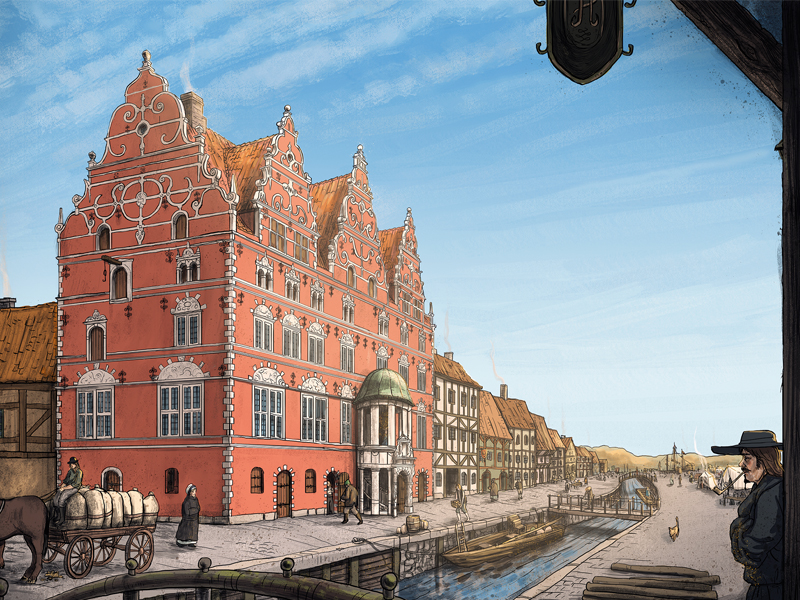
The famous stone house was built along Østerå, which at the time was a canal reinforced with quay walls and directly connected to the harbour front on the Limfjord. The building was thus constructed right on the quay, allowing goods arriving by ship – or destined for transport by sea – to be easily loaded and unloaded, rolled into the ground-floor stalls or hoisted up to the upper floors and attic storage areas.
Jens Bang, who had the house built in 1623–24, was at the time Aalborg’s leading merchant. He owned several properties in the city, but the new stone house became his main residence. Here he lived with his family and servants, ran his shop and storage facilities on the ground floor, and had ample space for warehousing on the upper floors and in the attics.
Although the building was highly functional, what first caught the eye was its sheer size and richly decorated façades. When newly built, the house was almost twice as tall as the other large merchant’s houses along Østerå – and even taller than the nearby town hall. Only the city’s church towers rose higher than this magnificent new structure.
Jens Bang’s Stone House was built in the Dutch Renaissance style and therefore resembles the great contemporary buildings lining the canals of cities such as Amsterdam. This architectural style was fashionable in Denmark at the time and is also characteristic of major landmarks such as Rosenborg Castle and the Børsen building in Copenhagen.
With its tall gables crowned by swirling sandstone ornaments reaching towards the sky, the magnificent building served as the wealthy merchant’s grand advertisement – impossible to overlook in Aalborg. Even today, the house remains a striking feature of the city skyline. The façades are richly decorated with ornaments, parrot heads, angel faces and devil masks. Originally, the bricks were painted red, while the sandstone details stood out in light colours. The sandstone portal was adorned with bright paint and gilding.
Jens Bang’s Stone House – in addition to sharing the same architectural style – has many other similarities with the Børsen building in Copenhagen, which also celebrates its 400th anniversary this year (2025), although unfortunately it was partially destroyed in the devastating fire on 16 April.
Both buildings were constructed for trade. Børsen was commissioned by King Christian IV as a central marketplace in the capital and as a symbol of Denmark’s rising status as an international trading and seafaring nation. Jens Bang’s Stone House in Aalborg was built for one of the wealthiest merchants of the time, who owned his own ships.
Both buildings are situated directly on the harbour quay. The ground floors were set up with market stalls, and both Børsen and Jens Bang’s Stone House were constructed and decorated in the same lavish style.
Jens Bang’s Stone House has, however, avoided the drastic restorations and reconstructions that Børsen has suffered. It has entirely escaped fire damage, and after the unfortunate blaze that destroyed much of Børsen, Jens Bang’s Stone House is even more important as a national historic landmark.
The Apothecary Moves In
After Jens Bang’s death, the building became known as Aalborg’s pharmacy. In 1670, the young and enterprising pharmacist Johannes Friedenreich purchased the house and converted it into a pharmacy, with a shop facing Østerå, a laboratory in the rear wing, and storage in the attic.
The pharmacist sold much more than the medicines he was obliged to keep in stock. In addition to dispensing medicine, he was also a specialty merchant for luxury goods and a wine dealer on a large scale. Through Europe’s major trading cities, the pharmacy had contacts in the world’s most exotic regions. The pharmacist kept almost 3,000 raw materials and finished medicines in jars and drawers – and if an item was not in stock, it could usually be obtained for customers who could afford it and were willing to wait.
In the stone house’s cellar were vats of wine from Germany, France, Greece, and Spain. Wine could be purchased by the bottle to take home, or enjoyed on site at the counter, as the pharmacy also functioned as a tavern.
350 Years of Pharmacy History
Aalborg’s pharmacy was one of Denmark’s first and for many years the northernmost. The nearest competitors were as far away as Viborg or Randers. Until the early 19th century, the Svane Pharmacy supplied the region with medicines and other apothecary goods from Aalborg all the way to Skagen and Thisted.
The pharmacy and its expertise were passed down through generations. If a pharmacist died prematurely, the widow would often marry a new pharmacist. For almost 350 years, Aalborg’s Svane Pharmacy and the pharmacist family lived in the building. When the pharmacy closed in 2013, it was the city’s oldest operating business.
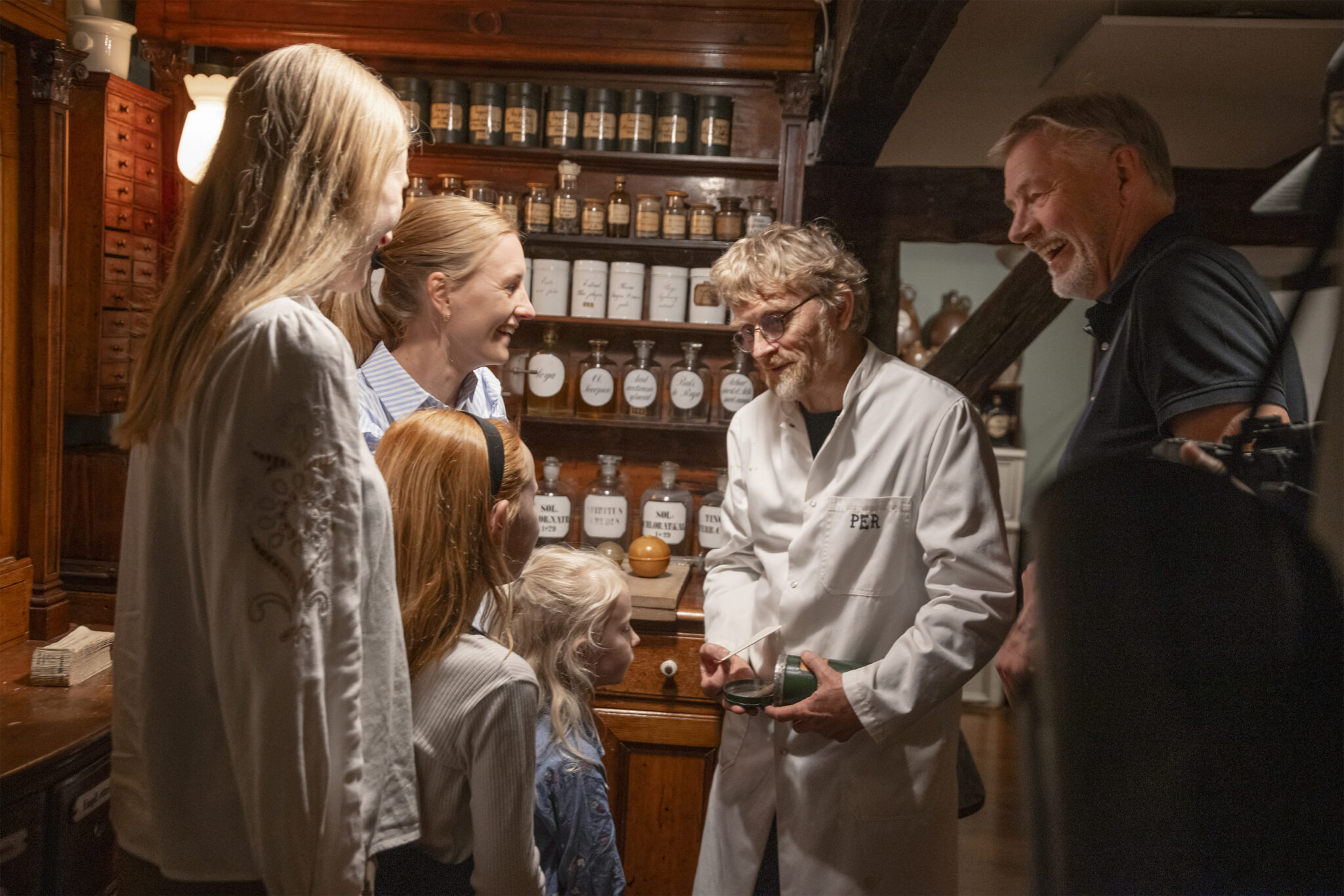
Today, the stone house is home to a restaurant, private residences, and a medical practice. In the attic, a museum has been created, displaying the old pharmacy’s equipment, laboratory tools, counters and drawers, jars and glass containers, and, not least, exotic medicines – all of which, over 350 years, were stored in the attic whenever the pharmacist family tidied up.